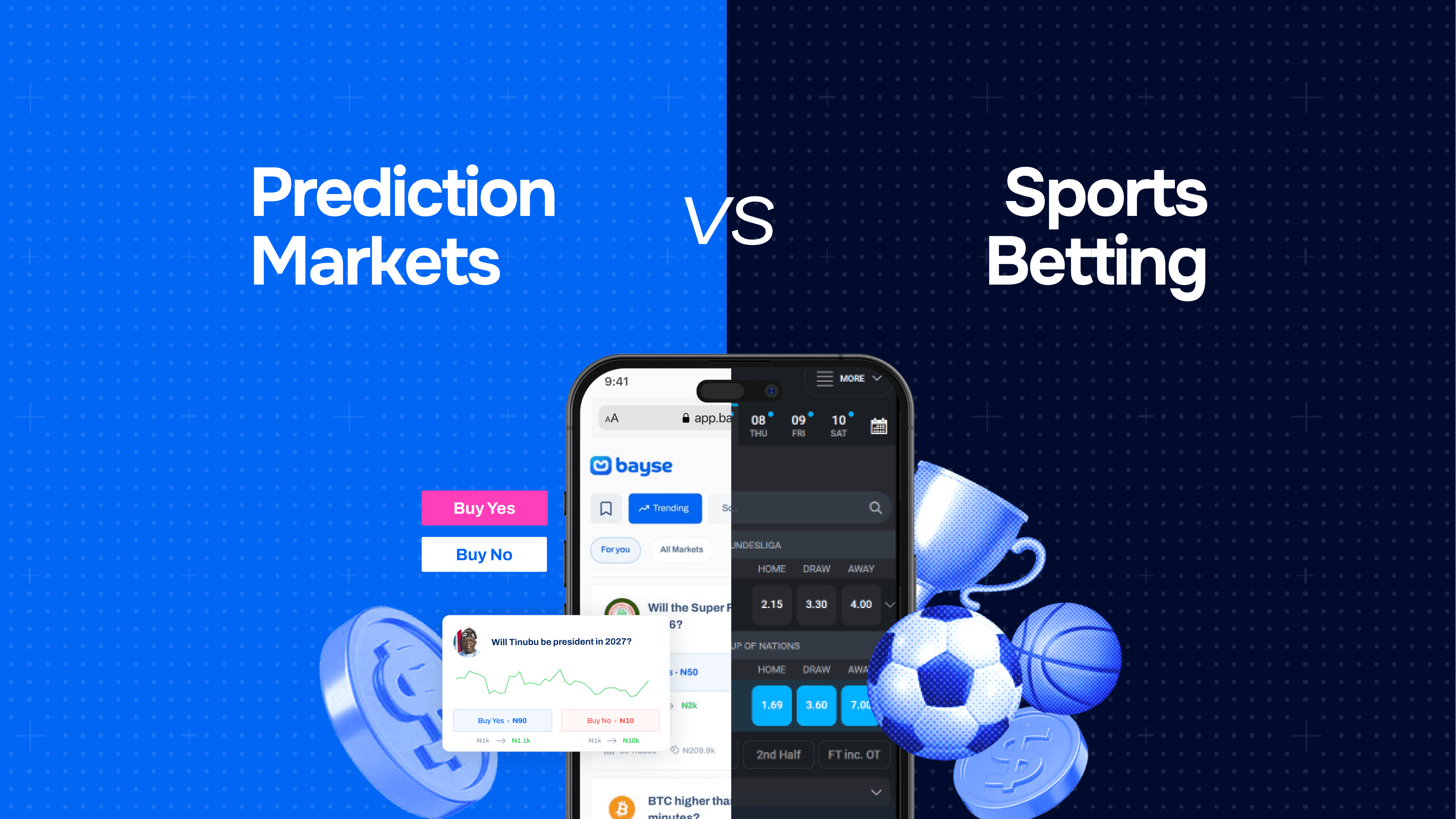
Prediction markets give you more control than sports betting in three specific ways: you trade at a price set by the crowd instead of a price fixed by a bookmaker, you can exit a position before the event ends instead of being locked in until full time, and you can act the moment you have better information instead of waiting for odds to catch up. Sports betting fixes both your price and your exit point for you. Prediction markets leave both in your hands. On Bayse, you can browse live sports markets and see this difference directly: real-time pricing, visible positions, and the ability to sell before an event resolves.
Key Takeaways
• Sports betting is a product with a seller (the bookmaker). Prediction markets are a marketplace with no seller, only traders on both sides.
• Bookmakers build a margin, called the overround, into every price before you place a bet. Industry pricing studies put this margin at roughly 5% to 15% depending on the market and sport.
• On a prediction market, YES and NO shares always sum to ₦100. Whatever you’re owed after a correct call is yours in full, with no house cut subtracted first.
• Prediction markets let you exit a position before the event ends. Sports betting locks your stake until the final whistle, full stop, election result, or resolution.
• Nigeria has roughly 60 million active bettors and a betting market worth over $3.6 billion, with football alone drawing 75% to 85% of all sports wagers. That’s the exact base prediction markets are built to compete for.
• The Iowa Electronic Markets, a real-money academic market run by the University of Iowa since 1988, has beaten national election polls roughly 74% of the time across five US presidential elections, evidence that crowd-priced markets tend to out-forecast fixed models.
• Start on Bayse with as little as ₦100, or read the full guide to trading prediction markets in Africa before you place your first trade.
Let’s be honest. The first time someone told you about prediction markets, your brain immediately went: “So… sports betting?”
It’s a fair reaction. On the surface, prediction markets and sports betting look related: both involve money, outcomes, and you being right about something. But they work completely differently, and that difference is why prediction markets have been quietly making people money for a while now and sportsbooks have been just as quietly taking it.
Here’s the thing nobody explains properly: sports betting is a product while a prediction market is a marketplace. One of those has a seller who needs to profit. The other one doesn’t. And that single structural fact is what decides who actually controls your prediction, you, or the platform.
The Real Difference: Who Actually Controls the Price
When you place a bet on SportyBet, you’re buying a product from a company. They set the price, decide the odds, and before a single naira changes hands, they’ve already taken their cut, usually somewhere between 8% and 12% of every bet placed. Whether you win or lose, they’ve already made money. That’s the business model. They can’t lose long-term as it’s literally built into the math.
This built-in margin has a name: overround, sometimes called vig or juice. It’s calculated by converting every outcome’s odds into an implied probability and adding them up. In a fair, no-margin market, those probabilities sum to exactly 100%. Bookmakers deliberately price markets above that, commonly 104% to 115% depending on the sport and market type, which is how a two-way market at even-money-style pricing can still guarantee the house a profit regardless of which side wins. You never see this number on the app. It’s baked into the odds before you ever open your betting slip.
Prediction markets are different in a fundamental way: there’s no seller. When you buy a “Yes Nigeria wins” contract on Bayse, you’re not buying it from Bayse. You’re buying it from another Nigerian who thinks Nigeria won’t win. Bayse is just the venue, like a stock exchange. The Lagos Stock Exchange doesn’t lose money when Dangote shares fall, it just facilitates the trade.
This matters more than it sounds. It means the price you see is the price the crowd actually believes, not a price padded to protect a bookmaker’s balance sheet.
Sports Betting vs Prediction Markets, Side by Side
| Sports Betting | Prediction Markets | |
| Who sets the price? | The bookmaker, before you ever see the odds | Everyone trading, in real time |
| Who controls your exit? | Nobody. You’re locked in until the final whistle | You. Sell your position whenever you want |
| Who pays when you win? | The house, after taking its cut | The trader who took the other side |
| What can you trade? | Mostly sports | Politics, FX, fuel prices, crypto, sports |
| Does the house profit regardless? | Always | Never |
| Can you see the order book? | No, prices are set and hidden from you | Yes, live YES/NO pricing is visible to everyone |
AFCON Final Proof: Same Prediction, Better Payout
Think back to the 2024 AFCON final, Nigeria vs Côte d’Ivoire. Most of Nigeria was confident. Super Eagles had been brilliant all tournament, and the bookmakers agreed. This is worth studying closely, because football alone accounts for the large majority of every naira wagered on betting apps in Nigeria, so this exact scenario is the one most Nigerian bettors actually live through.
Sportybet’s odds right before kickoff:
• Nigeria win: 2.10
• Côte d’Ivoire win: 3.50
Meanwhile on Bayse, the same event looked like this:
• Nigeria YES: 48 naira per share
• Côte d’Ivoire YES: 24 naira per share
Then Côte d’Ivoire won 2-1.
Here’s what that meant in your pocket:
• Sportybet: ₦1,000 bet on Côte d’Ivoire → ₦3,500 back.
• Bayse: ₦1,000 buys 41 shares at 24 naira each → ₦4,100 back when each correct share pays out ₦100.
Same call, same event but with ₦600 more profit, just by using a different platform.
That gap exists entirely because of the house margin. A sportsbook has to protect itself on both sides of every outcome. A prediction market doesn’t need to protect anyone. And there’s a second layer of control most people miss: on Bayse, if Côte d’Ivoire had gone 1-0 up at halftime and the market had already swung in your favour, you could have sold your position right then and banked the profit. With the Sportybet slip, you’re locked in from kickoff to final whistle no matter what happens on the pitch in between.
Why Prediction Markets Pay You More (The Simple Math)

In a prediction market, every event has two sides: YES and NO. And here’s the beautiful part, YES shares plus NO shares always add up to exactly ₦100. That’s the whole system.
If you buy a YES share for 65 naira and you’re right, you collect ₦100. Your profit is ₦35 per share. No platform skimming 10% of that. No house edge built into the calculation. The full ₦35 goes to you.
With sports betting it’s different. Bet ₦100 at even odds, win ₦190 maximum. That missing ₦10 went to the house. Always. On every bet. Forever. Widen that out with the overround math above and you’ll see why: a market priced at 110% overround means the bookmaker is guaranteed to keep roughly 9% to 10% of every naira wagered on that market, no matter who wins.
The opportunity in prediction markets, and this is key, is when the market price is wrong.
If everyone thinks there’s a 65% chance Nigeria beats Ghana, shares are trading at 65 naira. You’re convinced it’s closer to 80%. You buy at 65 naira. If you’re right, you collect ₦100. That 35 naira edge? It’s yours entirely. No sportsbook in the world offers you that logic, because they already took their cut before you even sat down.
The Control Sports Betting Never Gives You: Exiting Early
This is the part most comparisons skip, and it’s arguably the biggest practical difference between the two. A sports bet is a single, irreversible decision. You place it, and from that second until the final whistle, you have zero control over the outcome or your money. If the match turns against your prediction in the 60th minute, there’s nothing you can do but watch.
A prediction market position is not a single decision, it’s an ongoing one. Because YES and NO shares trade continuously on a live order book, their price moves in real time as new information arrives: a red card, a goal, a CBN announcement, a fuel supply update. That means you can:
• Sell a winning position early and lock in a smaller, certain profit instead of risking it on a result that hasn’t happened yet.
• Cut a losing position early and recover part of your stake instead of losing all of it, something a fixed sports bet never allows.
• Watch live pricing move as events unfold and react to it, instead of waiting powerlessly for a result you already committed to.
You can see this in practice by browsing live sports markets on Bayse, where prices update continuously as a match progresses, or by reading the full walkthrough on how prediction markets are traded across Africa if you want the mechanics laid out step by step before you place a trade.
Who Actually Wins on Prediction Markets? Real Nigerians with Real Information.
This is where prediction markets stop feeling like gambling and start feeling like being paid for knowing things.
The FX watcher. This person has CBN press releases bookmarked. They follow parallel market WhatsApp groups in three states. When a naira devaluation is coming, they feel it in the data before it shows up in headlines. On a market for “Will USD/NGN exceed 1,600 by month end?”, they’re not guessing. They’re reading.
The local expert. This person knows which filling stations in their local government area are the first to run dry on Thursdays. They know which NNPC allocation patterns signal a shortage is coming. People in Lagos are still arguing on Twitter about whether there’ll be a scarcity by Friday morning, this person already knew it’d start Thursday afternoon. That’s an edge.
The fast reader. This person saw the TechCabal or Nairametrics headline 90 seconds before the market odds updated. Ninety seconds in a liquid market is enormous. The window closes fast, but it exists. And the person who moves first gets the better price.
None of this is luck. It’s information arbitrage, you know something the person on the other side of your trade doesn’t. They’re pricing their position at 65 naira. You know it’s worth 80. You buy. The market eventually catches up to reality. That difference is your profit.
The scale of the audience this applies to is worth noting. Nigeria has an estimated 60 million active bettors and a betting market valued above $3.6 billion, with football responsible for 75% to 85% of all sports wagers placed, according to industry regulatory analysis. That’s tens of millions of Nigerians who already read match form, price fuel scarcity, and track naira movement as daily habits, without a mechanism to turn that knowledge into anything beyond bragging rights in a group chat. A prediction market is that mechanism.
Yes, You Can Lose, Here’s How to Not Be Stupid About It
Prediction markets aren’t a money printer. You’re trading against roughly 200,000 other people, some of whom know exactly what they’re doing. The absence of a house edge doesn’t mean the absence of risk.
A few rules that separate the people who profit consistently from the people who don’t:
• Only trade what you actually understand. If you don’t follow Nigerian politics closely enough to have a real opinion on who wins the Osun state governorship election, don’t trade it. Trade the things you genuinely know, the CBN decisions you follow, the sports teams you watch obsessively, the markets you’re navigating every single day.
• Risk 1–2% per trade, maximum. If your balance is ₦10,000, that’s ₦100–₦200 per position. This isn’t being timid. It’s the discipline that keeps you in the game long enough to actually get good. And if you have a huge appetite for risk, be our guest.
• Take profits when they’re there. Bought a position at 40 naira and it’s now trading at 65? The market is already more than halfway to agreeing with you. You don’t have to wait for resolution. Sell, take the profit, move on to the next one. This is the exit control a sportsbook can never give you, use it.
• Start embarrassingly small. ₦2,000 to ₦10,000. Lose some. Win some. Learn how the market moves before you commit serious money. Everyone who’s good at this was once bad at it.
Why Bayse Is Actually Different (Most “Prediction Markets” Aren’t)
This is worth saying plainly: a lot of platforms that use the words “prediction market” are still just bookmakers in different clothing. They’re setting the odds and building in their margin. While the framing changed, their structure didn’t.
What makes Bayse genuinely different isn’t branding, it’s mechanics:
• True peer-to-peer trading. No house taking a cut on your winnings. You’re trading against other Nigerians.
• Nigerian markets that actually matter. CBN rate decisions. Election results. Fuel queue timelines. Naira/USD direction. Not just sports, the events that shape life here.
• Exit before events end. If a market moves 30% in your favour before resolution, sell your position and lock in the profit. You cannot do this with sports betting.
• Regular Naira deposits and withdrawals. Bank transfers. No crypto required.
• Results from official sources only. CBN published rates. INEC official results. Verified match reports. No one disputes the outcome.
You can see the full range of markets, including live football, cup competitions, and player-level questions, on the Bayse sports markets page.
Do Prediction Markets Actually Beat Bookmakers? The Evidence Says Yes.
This isn’t a philosophical argument, there’s actual data.
The Iowa Electronic Markets, a real-money market run by the University of Iowa’s Tippie College of Business since 1988, has been directly compared against nearly 1,000 national election polls across five US presidential elections. The market’s price was closer to the eventual result than the polls were roughly 74% of the time. That’s not a one-off. It’s a multi-decade academic dataset.
Separately, the Hollywood Stock Exchange, a prediction market for entertainment outcomes, has been cited for years by analysts as a stronger read on major award results than fixed odds from sportsbooks in the same window, since its price reflects continuous trading rather than a single company’s opening line.
The reason isn’t mysterious. Markets pull information from thousands of people with real money on the line. Everyone buying a contract is saying “this is underpriced.” Everyone selling is saying “this is overpriced.” The price that settles in between is the most honest crowd estimate possible because everyone in that crowd has skin in the game.
A sportsbook’s odds reflect one company’s view of probability, plus their margin. A prediction market’s price reflects everyone’s view, weighted by how much they’re willing to bet on it.
The Bottom Line
Sports betting is entertainment where the house builds a profit into every single transaction. You can win, plenty of people do, but you’re always fighting a structural disadvantage that never disappears, and you never control your price or your exit.
Prediction markets in Nigeria are a skill game. The edge goes to whoever has better information, and the control stays with the trader from entry to exit. If you’ve lived in Nigeria for any length of time, you have information that most people don’t, about the economy, the politics, the fuel supply, the local conditions.
Bayse is built for exactly that. To let you trade that knowledge, on your terms, against people who know less than you do, without giving a middleman their guaranteed cut along the way.
If you’ve been giving SportyBet their margin for years, it might be time to stop.
Start trading on Bayse: app.bayse.markets/sign-up
New to prediction markets? Read the full guide: How to Trade Prediction Markets in Africa
Prediction Markets vs Sports Betting: Questions People Actually Ask
Which gives me more control, prediction markets or sports betting?
Prediction markets. You see live pricing set by other traders instead of a fixed price set by a bookmaker, and you can exit your position at any point before the event resolves. Sports betting locks your stake and your price the moment you place the bet.
Is this just sports betting with crypto?
No. Bayse runs in Naira and Crypto. No cryptocurrency needed or involved.
Can a regular person actually profit?
Yes, if you consistently know more than the average person on the other side of your trades. That’s a real condition, not a guarantee. But for people who closely follow Nigerian politics, FX movements, or specific industries, that condition is often met.
Is it legal in Nigeria?
Bayse operates information markets that resolve based on official public data, CBN-published exchange rates, INEC official results, verified match reports. The platform facilitates peer-to-peer trading on public information outcomes.
Sportybet or Bayse, which should I use?
They’re genuinely different things. Sportybet: sports only, bets locked until the event ends, house takes a margin on every transaction. Bayse: Nigerian events including politics and economics, exit positions early, no middleman margin. If you only care about sports or entertainment, either works. If you want to trade your knowledge of Nigeria, Bayse is built for that.
How much money do I need to start?
You can start with as low as ₦100. ₦5,000–₦10,000 is also a sensible starting balance. Risk ₦50–₦100 per trade while you’re learning. The goal is to start small enough that mistakes teach you without costing you badly.
