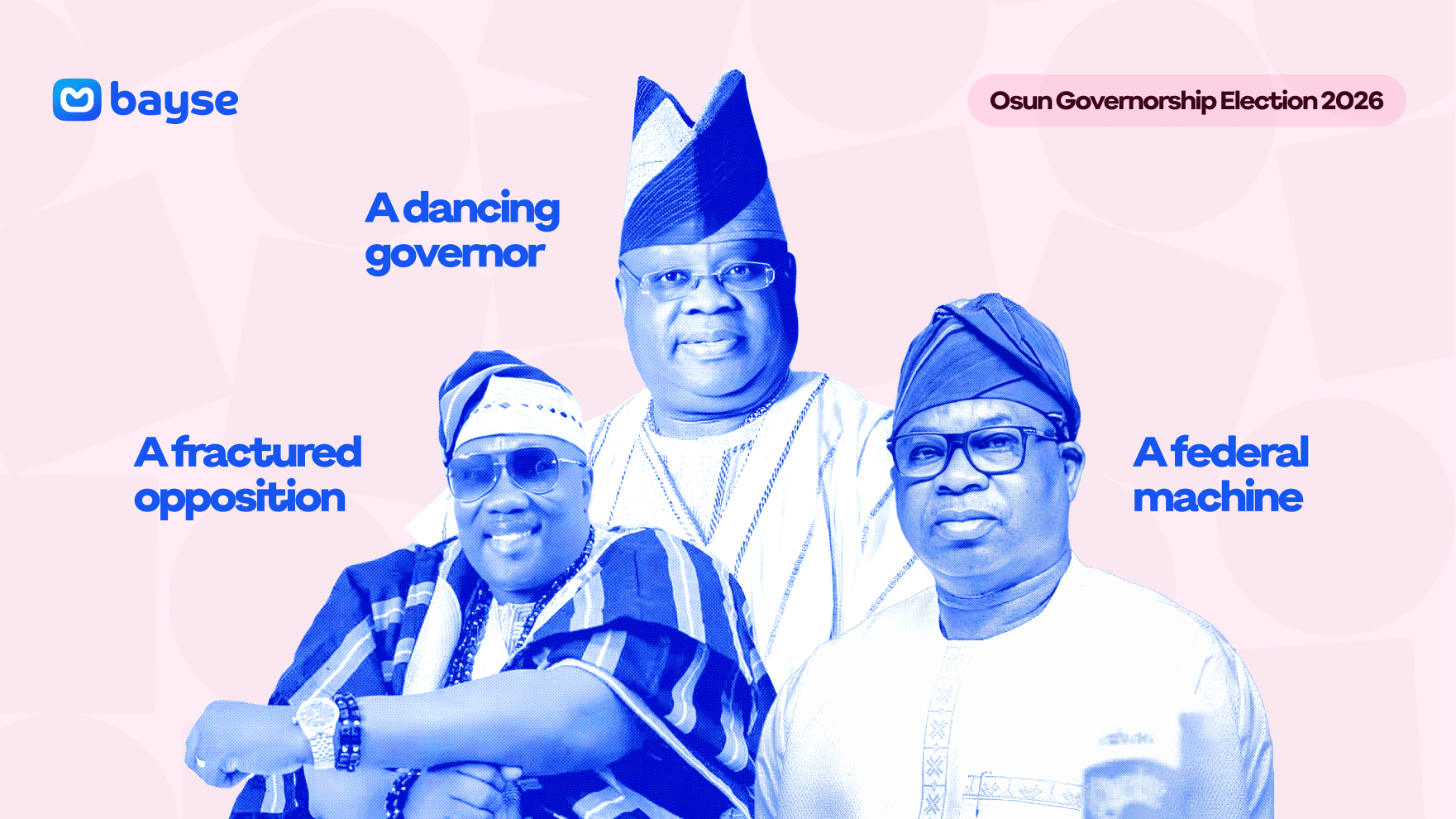
A dancing governor. A federal machine. A fractured opposition
The 2026 Osun governorship election takes place on August 15, and while it is officially an off-cycle state election, its implications stretch far beyond Osun.
Osun State does not make as much noise as Lagos. It does not carry the federal weight of Abuja. But what happens there on August 15th will be read very carefully by every political strategist, every party chairman, and every analyst trying to understand what 2027 actually looks like.
Because this election is not really about Osun. It is a dress rehearsal for the most consequential presidential election Nigeria has held since 2023.
Here is everything you need to know.
The Setup: Who Is Contesting the Osun Governorship Election?
Though six political parties are registered by INEC to participate in the August 15 governorship election, the contest for the number one seat is essentially between two main candidates, Senator Ademola Nurudeen Jackson Adeleke of the ruling Accord Party and Asiwaju Munirudeen Bola Oyebamiji of the APC.
Everything else is noise. This is a two-horse race.
CANDIDATE 1 — ADEMOLA ADELEKE (ACCORD)

The incumbent. The dancing governor. The man who did something nobody expected in 2022, he beat the APC machine in a state the party had controlled for years and delivered it to the PDP.
Except Adeleke is no longer PDP. He is seeking a second term on the platform of the Accord Party after his dramatic exit from the Peoples Democratic Party, following internal factional splits so bitter that the PDP failed to present a candidate on the final INEC cleared list at all.
Think about what that means.
The party that won Osun in 2022 is not even on the ballot four years later.
Adeleke is banking on the strength of incumbency and what he and his supporters refer to as his sterling performance in the infrastructure and health sectors. His campaign points to road projects, flyover bridges at Oke Fia and Lameco in Osogbo, and health sector investments as evidence of a productive first term.
He has taken his campaign directly into the heartland of the opposition, this week visiting Ikire, the hometown of the APC candidate, where he reminded residents he attended Nawairudeen Grammar School there and received their support in 2022. The audacity of campaigning in your opponent’s hometown is either supreme confidence or a very Nigerian kind of chess.
The criticism against him is equally specific. The opposition argues the roads his administration constructed are substandard, the flyover bridges are defective, and he has concentrated more infrastructure in his hometown of Ede than anywhere else in the state. The APC alleged that out of 876 teachers recruited, 88 slots went to Ede alone, while other towns received significantly smaller allocations.
Adeleke’s response is that his administration is blind to political affiliation in distributing projects. “Good governance should benefit all Osun people,” he said at a rally this week.Whether voters believe that may decide the election.
CANDIDATE 2 — MUNIRUDEEN BOLA OYEBAMIJI “AMBO” (APC)

The challenger. Former Managing Director and CEO of the National Inland Waterways Authority and former Osun Finance Commissioner, Oyebamiji is the APC’s bet to reclaim a state the party lost in what it still considers controversial circumstances.
The APC also enters the race with an advantage that extends beyond Osun.
As Nigeria’s ruling party at the federal level, it has access to national political structures and organisational networks that many analysts believe can influence the outcome of closely fought off-cycle elections.
That makes this contest about more than campaign rallies. It is also a test of whether incumbency inside Osun can withstand pressure from the country’s dominant political machinery. The APC also enters the race with an advantage that extends beyond Osun.
As Nigeria’s ruling party at the federal level, it has access to national political structures and organisational networks that many analysts believe can influence the outcome of closely fought off-cycle elections.
That makes this contest about more than campaign rallies. It is also a test of whether incumbency inside Osun can withstand pressure from the country’s dominant political machinery. The APC also enters the race with an advantage that extends beyond Osun.
As Nigeria’s ruling party at the federal level, it has access to national political structures and organisational networks that many analysts believe can influence the outcome of closely fought off-cycle elections.
That makes this contest about more than campaign rallies. It is also a test of whether incumbency inside Osun can withstand pressure from the country’s dominant political machinery. The APC also enters the race with an advantage that extends beyond Osun.
As Nigeria’s ruling party at the federal level, it has access to national political structures and organisational networks that many analysts believe can influence the outcome of closely fought off-cycle elections.
That makes this contest about more than campaign rallies. It is also a test of whether incumbency inside Osun can withstand pressure from the country’s dominant political machinery.The APC also enters the race with an advantage that extends beyond Osun.
As Nigeria’s ruling party at the federal level, it has access to national political structures and organisational networks that many analysts believe can influence the outcome of closely fought off-cycle elections.
That makes this contest about more than campaign rallies. It is also a test of whether incumbency inside Osun can withstand pressure from the country’s dominant political machinery.The APC also enters the race with an advantage that extends beyond Osun.
As Nigeria’s ruling party at the federal level, it has access to national political structures and organisational networks that many analysts believe can influence the outcome of closely fought off-cycle elections.
That makes this contest about more than campaign rallies. It is also a test of whether incumbency inside Osun can withstand pressure from the country’s dominant political machinery.The APC also enters the race with an advantage that extends beyond Osun.
As Nigeria’s ruling party at the federal level, it has access to national political structures and organisational networks that many analysts believe can influence the outcome of closely fought off-cycle elections.
That makes this contest about more than campaign rallies. It is also a test of whether incumbency inside Osun can withstand pressure from the country’s dominant political machinery.The APC also enters the race with an advantage that extends beyond Osun.
As Nigeria’s ruling party at the federal level, it has access to national political structures and organisational networks that many analysts believe can influence the outcome of closely fought off-cycle elections.
That makes this contest about more than campaign rallies. It is also a test of whether incumbency inside Osun can withstand pressure from the country’s dominant political machinery. The APC also enters the race with an advantage that extends beyond Osun.
As Nigeria’s ruling party at the federal level, it has access to national political structures and organisational networks that many analysts believe can influence the outcome of closely fought off-cycle elections.
That makes this contest about more than campaign rallies. It is also a test of whether incumbency inside Osun can withstand pressure from the country’s dominant political machinery.The APC also enters the race with an advantage that extends beyond Osun.
As Nigeria’s ruling party at the federal level, it has access to national political structures and organisational networks that many analysts believe can influence the outcome of closely fought off-cycle elections.
That makes this contest about more than campaign rallies. It is also a test of whether incumbency inside Osun can withstand pressure from the country’s dominant political machinery.The APC also enters the race with an advantage that extends beyond Osun.
As Nigeria’s ruling party at the federal level, it has access to national political structures and organisational networks that many analysts believe can influence the outcome of closely fought off-cycle elections.
That makes this contest about more than campaign rallies. It is also a test of whether incumbency inside Osun can withstand pressure from the country’s dominant political machinery.vThe APC also enters the race with an advantage that extends beyond Osun.
As Nigeria’s ruling party at the federal level, it has access to national political structures and organisational networks that many analysts believe can influence the outcome of closely fought off-cycle elections.
That makes this contest about more than campaign rallies. It is also a test of whether incumbency inside Osun can withstand pressure from the country’s dominant political machinery.The APC also enters the race with an advantage that extends beyond Osun.
As Nigeria’s ruling party at the federal level, it has access to national political structures and organisational networks that many analysts believe can influence the outcome of closely fought off-cycle elections.
That makes this contest about more than campaign rallies. It is also a test of whether incumbency inside Osun can withstand pressure from the country’s dominant political machinery.The APC also enters the race with an advantage that extends beyond Osun.
As Nigeria’s ruling party at the federal level, it has access to national political structures and organisational networks that many analysts believe can influence the outcome of closely fought off-cycle elections.
That makes this contest about more than campaign rallies. It is also a test of whether incumbency inside Osun can withstand pressure from the country’s dominant political machinery.The APC also enters the race with an advantage that extends beyond Osun.
As Nigeria’s ruling party at the federal level, it has access to national political structures and organisational networks that many analysts believe can influence the outcome of closely fought off-cycle elections.
That makes this contest about more than campaign rallies. It is also a test of whether incumbency inside Osun can withstand pressure from the country’s dominant political machinery.The APC also enters the race with an advantage that extends beyond Osun.
As Nigeria’s ruling party at the federal level, it has access to national political structures and organisational networks that many analysts believe can influence the outcome of closely fought off-cycle elections.
That makes this contest about more than campaign rallies. It is also a test of whether incumbency inside Osun can withstand pressure from the country’s dominant political machinery.The APC also enters the race with an advantage that extends beyond Osun.
As Nigeria’s ruling party at the federal level, it has access to national political structures and organisational networks that many analysts believe can influence the outcome of closely fought off-cycle elections.
That makes this contest about more than campaign rallies. It is also a test of whether incumbency inside Osun can withstand pressure from the country’s dominant political machinery.The APC also enters the race with an advantage that extends beyond Osun.
As Nigeria’s ruling party at the federal level, it has access to national political structures and organisational networks that many analysts believe can influence the outcome of closely fought off-cycle elections.
That makes this contest about more than campaign rallies. It is also a test of whether incumbency inside Osun can withstand pressure from the country’s dominant political machinery.The APC also enters the race with an advantage that extends beyond Osun.
As Nigeria’s ruling party at the federal level, it has access to national political structures and organisational networks that many analysts believe can influence the outcome of closely fought off-cycle elections.
That makes this contest about more than campaign rallies. It is also a test of whether incumbency inside Osun can withstand pressure from the country’s dominant political machinery. The APC also enters the race with an advantage that extends beyond Osun.
As Nigeria’s ruling party at the federal level, it has access to national political structures and organisational networks that many analysts believe can influence the outcome of closely fought off-cycle elections.
That makes this contest about more than campaign rallies. It is also a test of whether incumbency inside Osun can withstand pressure from the country’s dominant political machinery.The APC also enters the race with an advantage that extends beyond Osun.
As Nigeria’s ruling party at the federal level, it has access to national political structures and organisational networks that many analysts believe can influence the outcome of closely fought off-cycle elections.
That makes this contest about more than campaign rallies. It is also a test of whether incumbency inside Osun can withstand pressure from the country’s dominant political machinery.
The APC also enters the race with an advantage that extends beyond Osun.
As Nigeria’s ruling party at the federal level, it has access to national political structures and organisational networks that many analysts believe can influence the outcome of closely fought off-cycle elections.
That makes this contest about more than campaign rallies. It is also a test of whether incumbency inside Osun can withstand pressure from the country’s dominant political machinery.
The APC campaign council has stormed Ede, Adeleke’s own hometown, urging residents to vote for a candidate who “understands governance beyond entertainment.” The entertainment jab is a reference to Adeleke’s famous dancing, a cultural touch that endeared him to voters in 2022 but that the APC now uses to question the seriousness of his administration.
APC Director General Wole Oke stated that the party would remove Adeleke from office before 10pm on August 15, 2026. “Removing Adeleke is non-negotiable, as his days in office are numbered,” he said.
Bold language. The APC has been known to back bold language with institutional machinery that moves polling units.
THE WILD CARDS
The story does not end at two candidates.
Former Osun State Governor Olagunsoye Oyinlola has dumped Adeleke and endorsed the gubernatorial candidate of the Allied Peoples Movement, Adewale Adebayo, citing an APM/PDP alliance that he claims represents a genuine alternative to both the APC and Accord. Oyinlola is not a man whose endorsements are ignored in Osun politics, he governed the state from 2003 to 2010.
Adebayo framed the Osun election explicitly as a litmus test for 2027, saying a win in Osun would signal victory for his presidential candidate — Oyo State Governor Seyi Makinde. That framing tells you everything about what this election means beyond Osun’s borders. If Makinde’s camp can deliver a governorship in Osun, it demonstrates a level of political organisation that makes the 2027 presidential picture much more complicated.
There is also the only female candidate on the ballot — Adegabo Opawoye Yemisi of the ADP — whose candidacy in a race dominated by male political networks is itself a statement regardless of the outcome.
Osun Governorship Election 2026 by the Numbers
2.3 million registered voters across 3,763 polling units in 30 Local Government Areas.
Voter turnout in Osun has declined every election since 2003. In 2022 it hit a record low of 42.16%, meaning fewer than one in two registered voters actually cast a ballot.
Violence threatens this election according to recent reports, with tensions rising as both campaigns push into each other’s strongholds. Adeleke’s campaign team has also raised public concerns about INEC’s operational readiness, referencing logistical issues in recent regional bye-elections.
Low turnout plus violence concerns plus INEC readiness questions is a combination that historically benefits the candidate with the better ground organisation on election day. The APC’s federal backing gives them a structural advantage in that specific equation. Adeleke’s incumbency and local popularity are his counter.
Why the Osun Governorship Election Matters for 2027
The 2023 presidential election showed that fractured opposition is the incumbent’s best friend. Atiku, Obi, and Kwankwaso together polled nearly double what Tinubu polled, but they were not together.
Osun 2026 is showing something similar in miniature. Adeleke left the PDP. The PDP is not on the ballot. Oyinlola is backing a third party. The opposition that should theoretically combine against the APC is fractured across three different platforms — Accord, APM, and whatever remains of PDP influence.
If the APC wins Osun on August 15 by consolidating behind one candidate while the opposition splits itself, it tells the Tinubu camp exactly what they need to hear going into 2027, that the opposition has not learned the lesson of 2023.
If Adeleke holds Osun despite leaving his original party, running without the PDP structure, and facing federal headwinds, it tells a different story entirely, that grassroots popularity and incumbency can survive institutional opposition pressure. That story gives the NDC and ADC camps a blueprint.
Either way, August 15th is not just an Osun story.
WHAT TO TRADE ON BAYSE
The Osun governorship election market is live on Bayse, the first major electoral market since the 2027 presidential election markets launched.
Who wins? Adeleke’s incumbency and local support against Oyebamiji’s federal backing and APC machine. The market is pricing that question in real time.
That price is the most honest signal available about what Nigerians who are paying attention and putting real money behind their conviction actually believe will happen on August 15th.
Trade the Osun election on Bayse.
