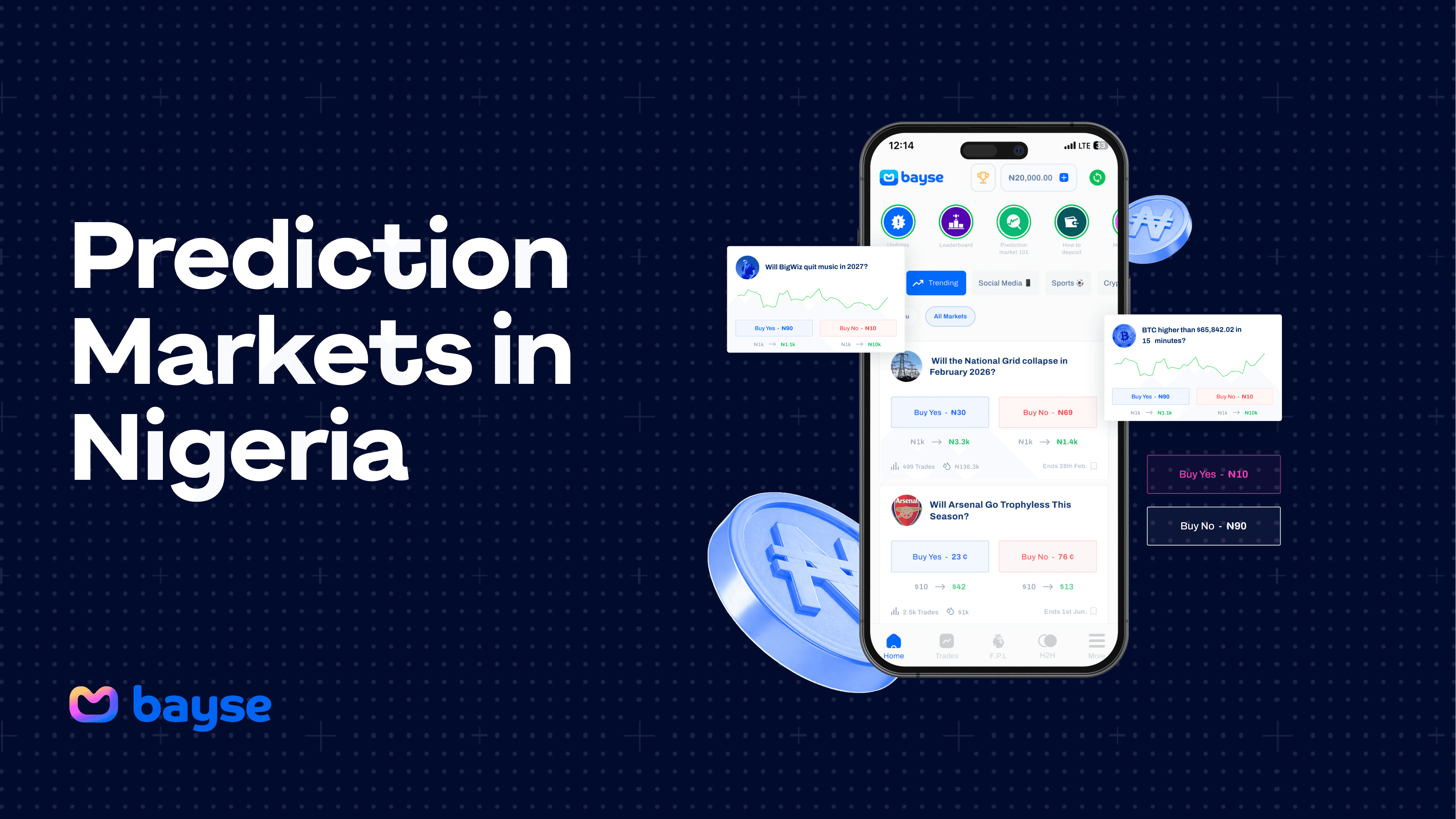
Prediction markets in Nigeria allow people to trade on whether real-world events will happen. Instead of simply saying you think Nigeria will win a football match, Bitcoin will reach a certain price, or the naira will move in a particular direction, you can take a YES or NO position and put money behind that prediction.
The price of each position changes based on what people in the market currently believe is likely to happen. For example, if a YES position is trading at ₦65, the market is roughly pricing that event at a 65% chance of happening. If new information comes out and more traders believe the event will happen, the price may rise. If confidence falls, the price may drop.
On Bayse, Nigerians can trade prediction markets across sports, finance, crypto, entertainment, politics and other real-world events. Nigerian users can also fund their accounts in naira, which removes the need to first open a foreign bank account or buy cryptocurrency before getting started.
This guide explains how prediction markets work in Nigeria, what YES and NO prices mean, how payouts work, what you can trade, how prediction markets differ from sports betting and how to start trading on Bayse.
What This Guide Covers
In this guide, you’ll learn:
- What prediction markets are and how they work in Nigeria
- What YES and NO prices mean
- How prediction market payouts are calculated
- How to sell a position before an event ends
- What Nigerians can trade on prediction markets
- The difference between prediction markets and sports betting
- How to start trading prediction markets on Bayse
- How to research markets and manage your risk
Prediction Markets in Nigeria at a Glance
| Question | Quick Answer |
|---|---|
| What is a prediction market? | A market where people trade on the outcome of future events. |
| How do you trade? | Buy YES if you think the event will happen or NO if you think it will not. |
| What does a ₦65 YES price mean? | The market is roughly pricing the outcome at a 65% probability. |
| What happens if you are correct? | On Bayse’s standard binary markets, a winning share pays ₦100 at resolution. |
| Can you sell before the event ends? | Yes, if there is enough liquidity for your order to be matched. |
| Can Nigerians deposit in naira? | Yes. Bayse supports a Naira Wallet funded through local bank transfer. |
| Do you need crypto? | No. Bayse also supports crypto, but Nigerian users can trade through the Naira Wallet. |
| What can you trade? | Sports, finance, crypto, politics, entertainment and other real-world events. |
What Is a Prediction Market?
A prediction market is a marketplace where people trade on the outcome of a future event. Every market starts with a question that can eventually be answered using a clear result.
For example, a market could ask whether Bitcoin will reach a particular price before the end of the year, whether Nigeria will qualify for a football tournament, or whether a major economic event will happen before a certain date.
Traders usually choose between YES and NO. If you believe the event will happen, you buy YES. If you believe it will not happen, you buy NO.
The price of those positions changes as people trade. If YES is selling at ₦65, traders are currently pricing that event at roughly a 65% probability. This does not mean the event will definitely happen. It simply shows what people participating in that market are currently willing to pay based on the information available to them.
As new information becomes available, people may change their views. This causes prices to move and is one of the main reasons prediction markets can react quickly to news, economic data, team announcements, crypto price movements and other developments.
How Do Prediction Markets Work?
The easiest way to understand prediction markets is with an example.
Imagine there is a market asking whether a particular event will happen before June 2027. YES is currently trading at ₦65 while NO is trading at ₦35.
You believe the event is more likely to happen than the market currently suggests, so you buy one YES share for ₦65. If the market eventually resolves YES and the winning share pays ₦100, your gross profit would be ₦35.
If the event does not happen and the market resolves NO, your YES share would settle at zero and you would lose the ₦65 used to buy it.
You also do not always have to wait until the final outcome. If you buy YES at ₦40 and new information later pushes the price to ₦70, you may be able to sell your position before the event ends and take the difference, provided there is enough activity in the market.
This means prediction trading is not only about choosing what will happen. It also involves deciding whether the current price properly reflects the probability of the event.
What Does a YES Price of ₦65 Mean?
A YES price of ₦65 means the market is roughly pricing the outcome at a 65% probability. A YES price of ₦25 suggests traders currently see the event as less likely, while a YES price of ₦85 suggests the market sees it as much more likely.
However, a higher price does not automatically mean it is a better trade.
Suppose YES is currently trading at ₦40, but after doing your research you believe the real chance of the event happening is closer to 70%. You may decide that YES is underpriced.
On the other hand, you may strongly believe an event will happen but find that YES is already trading at ₦95. At that point, most of the expected outcome may already be reflected in the price.
This is why people trading prediction markets need to think in probabilities. The question is not only, “Will this happen?” It is also, “Is the market currently pricing this event correctly?”
How Are Prediction Market Payouts Calculated?
On Bayse’s standard naira YES/NO markets, a winning share pays ₦100 when the market resolves, while the losing side settles at zero.
For example, imagine you buy 20 YES shares at ₦40 each. Your total position costs ₦800. If the event resolves YES, your 20 winning shares would be worth ₦2,000 in total.
That gives a gross profit of ₦1,200 before any applicable fees.
If the event resolves NO, those YES shares settle at zero and the ₦800 used to buy them is lost.
The price at which you enter a market therefore matters. Buying a winning outcome at ₦30 leaves more room between your purchase price and the ₦100 settlement value than buying the same outcome at ₦85.
Also Read: how prediction market winnings are calculated.
Can You Sell a Prediction Before the Event Ends?
Yes. You may be able to sell your prediction-market position before the final event happens.
Imagine you bought YES at ₦35. Two days later, an important announcement comes out and more traders become confident that the event will happen. The YES price rises to ₦72.
At this point, you can decide to continue holding your position until the event resolves or sell your shares at the higher market price.
This gives prediction-market traders more flexibility because you do not always have to wait until the final result before taking a profit or reducing a loss.
However, your ability to sell also depends on market liquidity. There needs to be another participant willing to take the other side of the trade at a suitable price.
How Are Prediction Market Prices Set?
Prediction market prices are mainly created by supply and demand.
Buyers place orders at prices they are willing to pay, while sellers place orders at prices they are willing to accept. When compatible orders meet, the trade happens.
As more people enter the market and react to new information, the price changes.
For example, the price of a football prediction may move after an injury is announced, a starting lineup is released or a team performs differently from expectations. A finance market may move after an inflation report, an exchange-rate change or a Central Bank of Nigeria announcement.
Crypto markets can also react quickly to Bitcoin price movements, regulation, major company announcements or wider market sentiment.
The price is therefore a live reflection of what traders are currently willing to pay for a particular outcome.
What Can Nigerians Trade on Prediction Markets?
Prediction markets are not limited to football. On Bayse, users can find markets across several areas, including sports, finance, crypto, entertainment, politics, culture, social media, technology and other current events.
The exact markets available change over time because they are connected to events that eventually happen and resolve.
Sports Prediction Markets
Sports markets can cover football matches, tournaments, qualifications, player awards and other sporting events. Someone who follows football closely may look at recent form, injuries, team selection, tactics and upcoming fixtures before taking a position.
Football is also a familiar entry point for many Nigerians because they already follow clubs, players and competitions closely.
Finance and Economy Prediction Markets
Finance prediction markets may cover exchange rates, inflation, interest rates, fuel prices and other economic events.
Someone who already follows CBN announcements, the naira, inflation figures or Nigerian financial news may have useful knowledge when analysing these markets.
Crypto Prediction Markets
Crypto prediction markets can ask whether Bitcoin or another digital asset will reach a certain price within a specific period.
When trading this type of market, it is important to check the exact price source and deadline stated in the rules because crypto prices can change quickly.
Entertainment and Culture Prediction Markets
Entertainment markets can cover music, awards, streaming, television, Nigerian artists, social media and other cultural events.
People who follow Nigerian entertainment closely may understand these markets better than someone who only sees the final headlines.
Explore our entertainment prediction markets and culture prediction markets.
Political Prediction Markets
Political markets can cover publicly verifiable outcomes such as elections, appointments and other political events.
Before trading these markets, it is important to read the resolution rules carefully and check the official source Bayse will use to confirm the outcome.
Bayse also has a Trading Prohibition and Integrity Policy restricting certain people with direct influence or material non-public information from trading relevant markets.
How Are Prediction Markets in Nigeria Different?
One of the biggest differences for Nigerian users is access.
Many global prediction platforms were originally built around users outside Nigeria. Some rely heavily on cryptocurrency or foreign payment systems, while many of their markets also focus more on events in the United States and Europe.
Bayse supports a Naira Wallet that can be funded through Nigerian bank transfer. It also provides a separate crypto wallet for users who prefer digital currencies.
This makes it easier for someone in Nigeria to participate without first opening a foreign account or buying crypto.
Local relevance is another difference. Nigerians already follow topics such as football, the naira, fuel prices, music, entertainment, politics and economic policy closely. Prediction markets built around these kinds of events allow people to trade on subjects they already understand and discuss every day.
Why Are Prediction Markets Growing in Nigeria?

Nigerians have always made predictions about the things happening around them.
People regularly debate where the naira is going, what the CBN will do next, whether fuel prices will rise, which football team will win, what Bitcoin will do and who will take home major entertainment awards.
For years, most of these predictions remained conversations on X, WhatsApp, Telegram or among friends.
Prediction markets turn that same behaviour into a structured market where people can compare their view with the probability currently reflected in the price.
Instead of only saying, “I think this will happen,” a trader can ask, “Do I think this event is more or less likely than the current market price suggests?”
This is what sets prediction markets apart because being correct about the eventual outcome is only one part of the decision you also get to price you pay for your outcome.
Prediction Markets vs Sports Betting: What Is the Difference?
Prediction markets and sports betting can look similar from the outside because both involve uncertain outcomes and real money. However, the way prices are formed is different.
In traditional sports betting, a bookmaker usually sets the odds and builds its margin into those prices.
In a prediction market, prices are created through buying and selling between market participants.
| Feature | Sports Betting | Prediction Market |
|---|---|---|
| Who sets the price? | Bookmaker | Buyers and sellers |
| Main focus | Sports | Sports, finance, crypto, politics, entertainment and more |
| Can prices move? | Yes | Yes |
| Can you sell before the event ends? | Depends on the sportsbook | Possible when there is enough liquidity |
| Pricing | Bookmaker odds | Supply and demand |
Prediction markets also cover far more than sports. Someone using Bayse could trade a football event and later look at a Bitcoin, entertainment or finance market.
For a deeper comparison, read Prediction Markets vs Sports Betting in Nigeria.
How to Start Trading Prediction Markets on Bayse
The first step is to create a Bayse account and complete the required verification.
Once your account is active, you can open your Naira Wallet and choose the deposit option. Bayse generates a virtual bank account that you can use to make the transfer from your Nigerian bank account.
After your wallet is funded, go to the Bayse markets page and browse the available events.
Start with something you understand. If you follow football closely, a football market may make more sense than a CBN interest-rate market. If you follow crypto every day, a Bitcoin market may be easier for you to analyse than an entertainment award.
Before buying anything, read the market question and resolution rules. Check exactly what needs to happen for YES to win, what counts as NO, when the market ends and which source will be used to confirm the result.
Then compare your own view with the current YES and NO prices.
If you decide to trade, choose your position, enter the amount you are comfortable risking and confirm the order.
After buying, you can continue monitoring the market. You may hold your position until the event resolves or sell earlier if the market moves and there is enough liquidity.
Read also: how to trade prediction markets.
Example of a Prediction Market Trade
Imagine a market asking whether Tinubu will be President will happen before December 31.
YES is currently selling at ₦30.
You have followed the event closely and believe it has a much higher chance of happening, so you buy 10 YES shares.
Your total cost is ₦300.
Two weeks later, new information comes out and YES rises to ₦65.
At this point, you can sell your shares at the higher price if there are buyers available, or you can continue holding until the event resolves.
If you hold until resolution and the outcome is YES, 10 standard winning shares at ₦100 each would give you a total payout of ₦1,000.
Since you originally spent ₦300, your gross profit would be ₦700.
If the market resolves NO, the YES shares settle at zero and you lose the ₦300 used to buy them.
This is why both the outcome and your entry price matter.
How to Research a Prediction Before Trading
Good prediction-market decisions usually start with good information.
If you are trading a football market, check recent form, injuries, confirmed lineups, fixture schedules and official club information.
If you are trading an economic market, look at primary sources such as Central Bank of Nigeria releases, official government data and recognised financial reports.
For crypto markets, check the exact price source and deadline stated in the market rules.
Entertainment traders should also separate rumours from confirmed announcements, especially when social media is moving quickly.
The goal is not to collect as many opinions as possible. The goal is to identify information that can genuinely change the probability of the event and decide whether the market has already reacted to it.
How to Get Better at Prediction Markets
One of the most useful habits is learning to think in probabilities instead of certainties.
You will rarely know an outcome with complete confidence. Instead, try to estimate the chance that the event happens and compare that with the market price.
It also helps to focus on subjects you already understand. Someone who follows football closely may perform better in football markets than in unfamiliar finance markets. Someone who follows crypto every day may understand Bitcoin-related events better than entertainment awards.
Keeping a record of your trades can also help. Write down why you entered the position, what information you used, what price you paid and what eventually happened.
Over time, you may notice that you make better decisions in some categories than others.
What Are the Risks of Prediction Markets?
Prediction markets involve real financial risk.
A position can move against you even when your original reasoning seemed strong. New information can appear, a trusted report can be wrong, or the market may interpret the same information differently from you.
Liquidity can also be a problem. If there are not enough buyers or sellers, you may not be able to exit at the exact price you want.
Most importantly, a position can lose its full value if the market resolves against you.
For this reason, only trade with money you can afford to lose. Money needed for rent, food, bills, school fees or other essential expenses should not be used for speculative trading.
Are Prediction Markets Legal in Nigeria?
Yes, prediction markets are legal in Nigeria. This is because they function as structured information markets, where positions settle against publicly verifiable data such as official election results, central bank publications, and confirmed match outcomes, rather than against a bookmaker’s internal odds.
As with any financial product, it is worth reading a platform’s terms carefully, understanding exactly how positions are structured, and staying aware of how relevant regulation applies to your situation. Bayse publishes its resolution criteria publicly for exactly this reason, so there is never ambiguity about how a specific market settles.
For a fuller breakdown of Bayse’s regulatory position and how it addresses the questions Nigerian traders actually ask, see our full page on legality and legitimacy.
Why Prediction Markets Matter Beyond Money
Prediction markets can also provide useful information about what a group of people currently believes is likely to happen.
Imagine YES is trading at ₦25 in the morning. An important announcement comes out and, within a few hours, the price rises to ₦70.
Even if you never enter the trade, that movement shows that people participating in the market have become much more confident about the event.
This is one reason economists and researchers have studied prediction markets for decades. Market prices can act as another signal of changing expectations because participants are putting money behind their views.
Prediction markets are not always correct. Traders can overreact, important information can be missing and markets can still get outcomes wrong. However, the movement in prices can still provide useful information about how expectations are changing.
The Bottom Line
Prediction markets in Nigeria give people a structured way to trade their views on real-world events.
A market starts with a clear question. You buy YES if you believe the event will happen or NO if you believe it will not. The price changes as traders buy, sell and react to new information.
On Bayse, Nigerian users can fund their accounts in naira and explore prediction markets covering sports, finance, crypto, entertainment, politics and other events.
The most important thing is to understand the market before placing a trade. Read the rules, check reliable sources, compare your own probability estimate with the current price and only use money you can afford to lose.
You can explore current prediction markets on Bayse.
Frequently Asked Questions About Prediction Markets in Nigeria
What is a prediction market?
A prediction market is a marketplace where people trade on whether a future event will happen. Traders normally choose YES or NO, while the price changes based on what buyers and sellers currently believe about the outcome.
How do prediction markets work in Nigeria?
Nigerian users can fund an account on a supported prediction-market platform, choose a real-world event, buy YES or NO shares and either hold the position until the market resolves or sell earlier when there is enough liquidity.
What does ₦65 YES mean?
A YES price of ₦65 means the market is roughly pricing the outcome at a 65% probability. Traders can compare that market probability with their own research before deciding whether to buy.
How are prediction market payouts calculated?
On Bayse’s standard naira markets, a winning share pays ₦100 while the losing side settles at zero. Your profit depends on your purchase price and the number of shares you own.
Can Nigerians use naira for prediction markets?
Yes. Bayse provides a Naira Wallet that can be funded through Nigerian bank transfer.
Do I need crypto to use Bayse?
No. Nigerian users can fund their Naira Wallet through bank transfer. Bayse also provides crypto funding options for users who prefer them.
Can I sell before the event ends?
Yes, where there is enough liquidity. You may be able to sell your shares before the final result instead of waiting for the market to resolve.
What can I trade on prediction markets in Nigeria?
Prediction markets can cover football and other sports, finance, cryptocurrency, politics, entertainment, culture, technology and other real-world events.
Are prediction markets the same as sports betting?
No. Traditional sportsbooks usually set their own odds, while prediction-market prices are created through buying and selling between market participants.
Can I lose money on prediction markets?
Yes. If a market resolves against your position, you can lose the money committed to that trade. Prediction markets are speculative, so only use money you can afford to lose.
How should a beginner start?
Start with a topic you already understand. Read the full market question, check the resolution rules, use reliable information and compare your own estimate with the current market price before taking a position.
