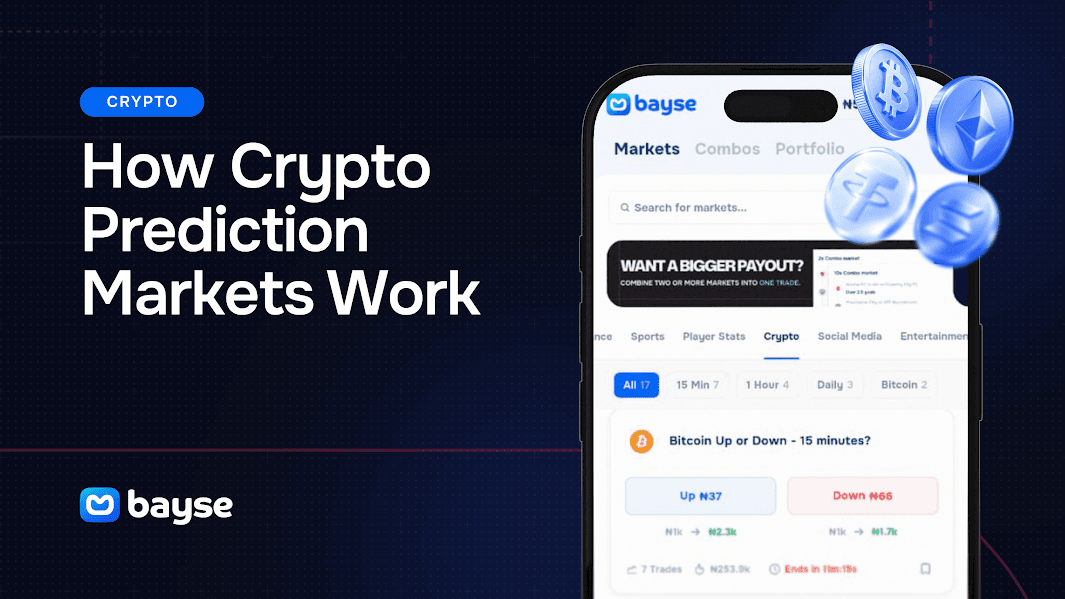
Bitcoin does not need to reach $100,000 for someone to make money from predicting its price. What matters is the exact outcome being traded, the price paid for that prediction and whether it eventually happens.
On Bayse, crypto prediction markets allow eligible users to buy YES or NO shares on specific cryptocurrency outcomes. Each share in a standard binary market pays ₦100 if the chosen outcome is correct and ₦0 if it is wrong.
You do not need to own Bitcoin to participate. You are trading an outcome linked to Bitcoin’s price, not purchasing the cryptocurrency itself.
Here is how that works in practice.
What Is a Crypto Prediction Market?
A crypto prediction market allows people to trade on the likelihood of a specific cryptocurrency event happening.
For example, a market might ask:
“Will Bitcoin be worth at least $90,000 at 11:59 PM UTC on December 31, 2026?”
There are two possible positions.
Buying YES means you believe Bitcoin will meet or exceed that price at the specified time.
Buying NO means you believe it will not.
Once the event is settled, the winning outcome receives the stated payout.
Unlike buying Bitcoin on an exchange, you do not need its price to keep rising after your prediction. Your position depends on the conditions in the market question.
You can explore the different types of cryptocurrency outcomes on the Bayse Crypto Markets page.
A Simple Bitcoin Prediction Market Example in Naira
Imagine Bayse lists the following market:
“Will Bitcoin be at or above $90,000 on December 31, 2026?”
This is an illustrative example, not a live market quotation.
Suppose YES shares are available at ₦40 each.
That price suggests the market is roughly assigning a 40% probability to the outcome, although the actual likelihood could be higher or lower.
You believe Bitcoin has a better chance of reaching the target, so you purchase 50 YES shares.
Your calculation would look like this:
| Transaction | Amount |
| Price per YES share | ₦40 |
| Shares purchased | 50 |
| Total purchase cost | ₦2,000 |
| Payout if YES wins | ₦5,000 |
| Gross profit if YES wins | ₦3,000 |
| Loss if YES loses | ₦2,000 |
If Bitcoin meets the specified condition, your 50 shares would pay ₦5,000.
Subtracting the initial ₦2,000 cost leaves a gross profit of ₦3,000 before any applicable fees.
If Bitcoin fails to meet the condition, the YES shares expire worthless, and the ₦2,000 spent is lost.
This is why understanding your entry price matters as much as predicting the eventual outcome.
What Do YES and NO Prices Mean?
Prediction market prices reflect what participants are collectively willing to pay for an outcome.
For a standard ₦100 payout share, a YES price of ₦70 roughly corresponds to a 70% implied probability.
A price of ₦25 roughly corresponds to 25%.
However, these percentages are not guaranteed forecasts. Prices can be influenced by trading activity, available liquidity, spreads and new information.
Consider a Bitcoin market where YES trades at ₦80.
Even if you strongly believe the event will happen, purchasing at ₦80 leaves only ₦20 in potential gross profit per winning share.
Buying that same outcome at ₦40 would leave ₦60 in potential gross profit.
The difference is the price you pay for the same possible payout.
This is why experienced participants pay attention to both the likelihood of an event and the amount the market is charging for that outcome.
Which Cryptocurrency Markets Can You Find on Bayse?
Bayse lists different types of cryptocurrency predictions, depending on market availability.
Price target markets ask whether an asset will reach or remain above a specified price.
Short-term direction markets ask whether Bitcoin or another cryptocurrency will move up or down during a particular period. Bayse has listed Bitcoin Up or Down markets covering 15-minute intervals.
Relative performance markets compare two assets. For example, Bayse has listed a market asking whether Bitcoin will outperform gold in 2026.
These questions measure different things.
Bitcoin could fall in price but still outperform gold if gold falls by a greater percentage.
Likewise, Bitcoin could rise during a trading day but fail to meet the precise closing condition of a price target market.
Browse Bitcoin prediction markets on Bayse to see which outcomes are currently available.
How Are Crypto Markets Settled?
Each market has rules specifying exactly what must happen for an outcome to win.
For cryptocurrency markets, the rules may identify a particular price feed, timestamp and comparison method.
Some short-term Bitcoin markets on Bayse use Chainlink’s 60-second time-weighted average price, or TWAP, to determine the result.
That matters because a price displayed on one exchange may differ from the value used by the market’s official settlement source.
Before purchasing shares, read the market question, closing time, settlement rules and specified data source.
An outcome is determined by those rules, not by whichever cryptocurrency price appears on your preferred chart.
Can You Sell Before the Market Ends?
You do not always have to wait until the final outcome.
Suppose you purchased 50 YES shares at ₦40, spending ₦2,000.
A positive Bitcoin development increases demand, and buyers are later willing to purchase those shares for ₦65 each.
Selling all 50 at that price would return ₦3,250, representing a gross profit of ₦1,250 before fees.
But this depends on the market remaining open and there being enough liquidity to complete the sale.
The price can also move against you, leaving you with a smaller cash-out value than your original purchase cost.
How to Start Using Crypto Prediction Markets on Bayse
Visit Bayse and sign in to an eligible account.
Open the Crypto category and choose a market you understand. Read its rules carefully, particularly the price condition and settlement deadline.
Compare the available YES and NO prices before choosing your preferred outcome.
For Nigerian users, Bayse supports a naira wallet, so participation does not require buying Bitcoin first.
Before confirming any position, check the total cost and possible payout shown on the platform.
Crypto prediction markets involve financial risk, and an incorrect prediction can result in losing the amount committed. Want a full walkthrough of the platform first? Read the beginner’s guide to using Bayse.
Frequently Asked Questions
Do I need Bitcoin to trade crypto prediction markets on Bayse?
No. You can participate in eligible naira-denominated cryptocurrency prediction markets without owning Bitcoin. You are purchasing shares linked to an event outcome.
How much does a winning share pay?
In Bayse’s standard binary prediction markets, a winning share pays ₦100, while a losing share pays ₦0.
Can I lose my money?
Yes. If your selected outcome is incorrect, you can lose the amount spent on the shares. Selling early can also result in a loss.
Does a ₦60 YES price mean Bitcoin has a 60% chance of reaching the target?
It represents approximately 60% implied market probability, not a verified statistical forecast or guarantee.
Where can I find Bitcoin prediction markets?
Visit the Bayse Bitcoin Markets page to review available outcomes, prices and rules.
Explore Crypto Prediction Markets on Bayse
Every cryptocurrency market begins with a specific question, but the price, deadline and settlement rules determine what you are actually trading.
Understanding those details helps you assess whether a prediction is worth its current market price.
Explore crypto prediction markets on Bayse, then follow this guide to making your first prediction when you are ready to trade.
Prediction markets carry financial risk. Participation is restricted to eligible users aged 18 or older and may be unavailable in certain jurisdictions. Bayse does not provide investment or financial advice.