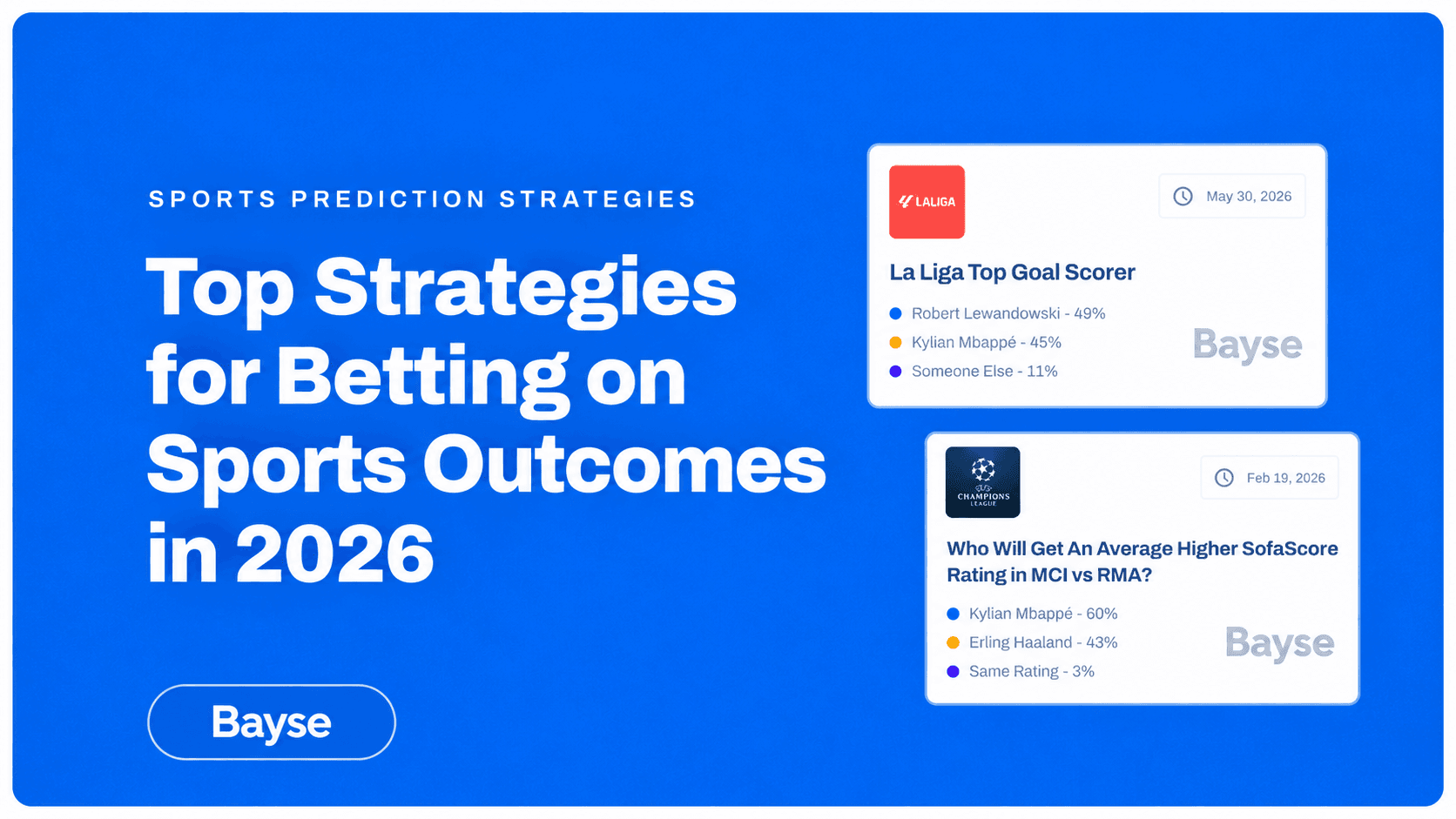
The best sports betting strategy in 2026 is not a single system or a guaranteed winning formula. It is a repeatable process: set a strict budget, understand the market question, estimate probability from reliable information, compare your estimate with the market price, and record every decision. That process can improve consistency, but every position can still lose.
Bayse is a prediction-market platform, not a traditional fixed-odds sportsbook. On Bayse, users take YES or NO positions on clearly defined outcomes.

Want a broader introduction to prediction markets? Read How to Profit from Predictions on Real-World Events.
Key Takeaways
- No sports betting or prediction-market strategy guarantees a profit.
- Protect your bankroll first: use a fixed budget, small position sizes and firm stop limits.
- Read the exact market question, deadline and settlement conditions before taking a position.
- Look for value by comparing an evidence-based probability estimate with the market price—not by automatically backing the favourite.
- Team news, injuries, tactics, schedule, venue, weather and verified live events can change probability.
- Specialising in one sport or league makes it easier to recognise meaningful information.
- Keep a record of your reasoning and results so you can improve the process, not just remember wins.
- Use AI as a research assistant, never as proof that an outcome will happen.
Sportsbook Betting and Bayse Prediction Markets: What Is Different?
The same research and risk principles can apply to both, but the mechanics are different. Understanding that difference prevents readers from treating a Bayse market like a standard bet slip.
| Feature | Traditional sportsbook | Bayse prediction market |
| What you choose | A bet offered at fixed or changing odds | A YES or NO position on a defined outcome |
| Price | Odds set by the sportsbook | A market price that can move as participants react |
| Decision focus | Whether the offered odds provide value | Whether the market price differs from your probability estimate |
| Position changes | Cash-out may be offered at the operator’s discretion | Selling or adjusting depends on whether the market and relevant feature remain available |
| Risk | The stake can be lost | The amount committed to the position is at risk |
1. Set a Bankroll and Position Size Before You Trade
Your bankroll is the total amount you have set aside for sports prediction trading. It should be separate from rent, bills, savings and emergency money. Decide the maximum amount before opening a market—not after a loss.
Set a fixed budget. Use only money you can afford to lose completely.
Choose a small unit. A cautious beginner might use a small percentage of the bankroll for one position. The right limit depends on personal circumstances; it is not a profit formula.
Set session limits. Decide when you will stop for the day based on money and time.
Never chase losses. Increasing position size to recover a loss can turn one poor decision into a much larger problem.

2. Read the Market Question and Settlement Rules
Before analysing the teams, analyse the question. A strong prediction on the wrong interpretation is still a bad trade. Check:
- the exact event and outcome being measured;
- the closing time and the period of play included;
- whether extra time, penalties, postponements or cancellations count;
- the source Bayse will use to settle the market; and
- whether the position can still be adjusted after you enter.
If any condition is unclear, do not assume. Review the market details or ask Bayse support before trading.
3. Look for Value, Not Just the Most Likely Winner
Value exists when your evidence-based estimate of an outcome differs meaningfully from the market’s implied probability. A favourite can be a poor position if the price already reflects its strength. An underdog can also be poor value if the evidence does not support the market price.
| Simple example: suppose a market price represents roughly a 40% chance, while your research suggests 55%. The 15-percentage-point difference is a possible value signal—not proof of a win. Your estimate may be wrong, the information may already be incomplete, and fees or market mechanics can affect the result. |

4. Use Relevant Data and Context
Good analysis combines numbers with context. Historical statistics alone can mislead when a squad, coach, venue or schedule has changed.
- Recent performance: use an appropriate sample rather than one unusually good or bad match.
- Availability: confirm injuries, suspensions, rotation and late team news.
- Underlying performance: examine chance quality, shot quality, possession value, efficiency or other sport-specific measures—not only final scores.
- Matchup and tactics: consider how the teams’ styles interact.
- Schedule and venue: travel, rest, home advantage, surface and weather may matter.
- Source quality: prioritise official team or league information and reputable reporting.
For football-specific research, see How to Predict Football Matches Correctly.
5. Time Your Entry and Treat Live Information Carefully
Prices can move when line-ups, injuries, weather or in-game events change expectations. Speed can matter, but reacting first is not useful if the information is false or already reflected in the price.
- Verify breaking news before acting.
- Ask whether the new information materially changes the probability.
- Check whether the price has already moved enough to remove the value.
- Avoid emotional reactions to one goal, one scoring run or one dramatic moment.
- Only adjust or exit a position when that function is available and you understand the current price.
6. Specialise in One Sport, League or Market Type
Specialisation reduces noise. Following one competition closely helps you understand team rotation, coaching changes, local reporting, scheduling and which statistics matter. Start with a market you already understand, then expand only when your records show a repeatable process.
Do not assume a smaller or less popular competition is automatically easier. Thin information, limited coverage and lower market activity can create additional uncertainty.
7. Keep a Prediction Journal
Memory favours dramatic wins and forgets weak reasoning. A written record shows whether your process is improving.
- market question and date;
- YES or NO position and entry price;
- your probability estimate and key evidence;
- amount risked;
- new information received after entry;
- result and net outcome; and
- one lesson for the next decision.
Review groups of decisions, not one result. A good decision can lose, and a poorly researched decision can win. The goal is to improve the quality and consistency of the process.
8. Use AI and Prediction Tools as Assistants
AI tools can summarise reports, organise historical data, compare scenarios and help test a model. They can also use stale data, misunderstand a market question or produce confident but incorrect claims.
- Check every important claim against a reliable source.
- Confirm the data cut-off and whether line-ups or injuries are current.
- Do not paste private account, payment or identity information into an AI tool.
- Treat model output as one input, not a command to trade.
- Keep your own risk limits even when a tool reports high confidence.
When Hedging or Exiting May Help
If a market remains open and Bayse allows you to sell or adjust a position, reducing exposure may help manage risk after the price changes. This is not guaranteed to lock in a profit. The available price, liquidity, fees and market rules all matter. Never take the opposite side automatically; first calculate the total amount at risk under each possible outcome.
Common Mistakes to Avoid
- Trading because you support a team rather than because the price offers value.
- Ignoring the exact wording or settlement conditions.
- Risking too much on one market or combining several correlated opinions.
- Chasing losses or increasing size after a short winning streak.
- Using outdated statistics or unverified social-media news.
- Assuming AI confidence is the same as probability.
- Judging a strategy only by its recent results instead of the quality of the decisions.
- Trading when tired, angry, under pressure or using money needed elsewhere.
Frequently Asked Questions
What is the best sports betting strategy for beginners?
Start with bankroll management. Set a fixed budget, size individual trades at 1 to 5% of your funds, and never chase a loss. Everything else in this guide builds on that foundation.
How can I get better sports betting odds?
Trade on data and trends instead of gut instinct, and act quickly when new information moves the market. Value trading, comparing your own analysis against the market’s price, is where most of the edge comes from.
Is Qalla by GoWagr the same as Bayse?
Yes. Qalla by GoWagr has rebranded to Bayse. The trading mechanics described in this guide- shares, live pricing, and market-based trading- work the same way under the new name.
Does Bayse offer built-in AI prediction tools?
Not directly. You can still use external AI-powered prediction services or your own models alongside Bayse to sharpen your trading decisions.
The Bottom Line
Sports trading in 2026 rewards preparation over instinct. Data, timing, and discipline consistently outperform a hot streak of gut calls. Apply these strategies with a fixed bankroll and a clear head, and you put the odds back in your favor.
Ready to put these strategies to work? Sign up for Bayse and start trading on sports outcomes today.
Sign up on Bayse →