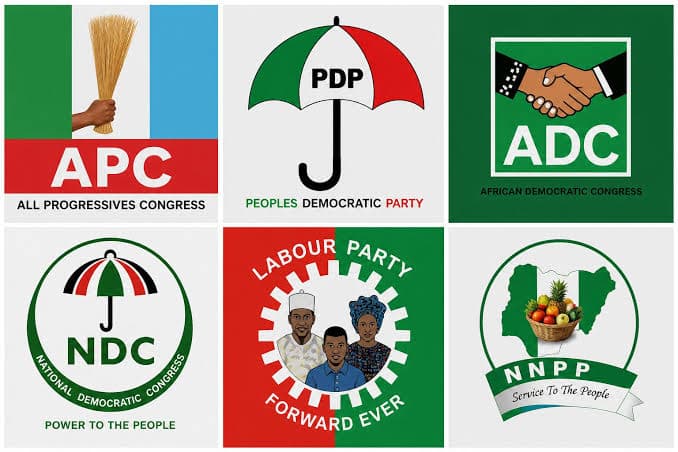
The APC, ADC and NDC are three of the main party names to watch in Nigeria’s 2027 presidential election. INEC’s published list pairs Bola Ahmed Tinubu with the APC, Atiku Abubakar with the ADC and Peter Obi with the NDC. A party-winner market lets traders focus on which party takes the presidency, without needing to choose a specific candidate-level position.
The distinction matters because a party market follows the party attached to the winning presidential ticket. It is not a market on which individual candidate will lead the vote at an interim stage, nor does it settle questions about alliances unless the market rules explicitly address them.
Check out the full 2027 presidential election market on Bayse.
Which parties are contesting the 2027 presidential race?
INEC’s final list published in September 2026 named 18 presidential candidates from 18 political parties. Among them are the three parties highlighted in this market angle:
| Party | Presidential candidate | Running mate |
| APC | Bola Ahmed Tinubu | Kashim Shettima |
| ADC | Atiku Abubakar | Rotimi Amaechi |
| NDC | Peter Obi | Rabiu Kwankwaso |
The candidate-party pairings above follow INEC’s published list. The wider field also includes candidates from the APM, PDP, PRP, AAC and other parties. A market that lists only APC, ADC and NDC should therefore be read according to its exact outcomes: it may be a selected-outcomes market rather than a complete list of every party on the ballot.
What does an APC vs. ADC vs. NDC market measure?
A party-winner market asks which party’s presidential candidate will be declared the winner of the 2027 presidential election. It gives participants a way to compare party-level prospects rather than buying YES shares on individual candidates in separate markets.
For example, a trader who expects the APC ticket to win could take a YES position on APC. A trader who expects the ADC ticket to win could choose ADC YES. A trader who believes the NDC ticket will win could choose NDC YES. The exact availability of YES and NO positions, payouts and treatment of an unlisted party depends on Bayse’s published market rules.
Before trading, check whether the market includes all eligible parties, how it treats a candidate changing party or a party alliance, and which official result determines the winner. If the listed outcomes are only APC, ADC and NDC, the rules should explain what happens if another party wins.
APC: the incumbent party’s route to victory
The APC is the governing party, and its 2027 presidential candidate is incumbent President Bola Tinubu. Incumbency gives the party the advantage of national visibility and an established political structure. The party’s campaign will seek to defend the administration’s record and maintain support across the federation.
The main challenge is public assessment of the administration’s performance. Economic conditions, household costs, security and confidence in the government’s reform programme are likely to shape campaign debate. The APC needs its support to translate into votes across enough states, not only a strong national total.
ADC: Atiku’s party-level challenge
Atiku Abubakar is the ADC’s presidential candidate, with Rotimi Amaechi listed as his running mate. The ADC’s prospects will depend on the strength of its organisation, its ability to attract voters beyond its established base and whether it can build a broad coalition.
Party identity is particularly relevant in this race because Atiku’s move to the ADC changes the party comparison from earlier election cycles. Traders following the ADC should distinguish the candidate’s personal political network from the party’s ability to mobilise and coordinate support nationwide.
NDC: Obi and Kwankwaso’s electoral coalition
Peter Obi is the NDC’s presidential candidate, with Rabiu Kwankwaso as his running mate. Their ticket brings together two recognisable political figures with different regional support bases.
The NDC’s challenge is to turn that profile into a national party operation capable of competing across all regions. The running-mate partnership may influence the party’s reach, but its effect will depend on campaign organisation, voter response and the broader political environment.
How do you compare the three parties on Bayse?
The most useful comparison starts with the live market data. Review the YES price for each party, the available NO prices if offered, trading activity and the precise wording of the resolution rules.
No verified live Bayse prices for an APC-versus-ADC-versus-NDC party-winner market were available in the public material reviewed for this draft. Insert the live prices and trade counts from the Bayse market page before publication. Do not reuse candidate-level prices as party-level odds: they are different market questions and may have different rules
.
| Comparison point | Questions for traders |
| Market price | Which party has the highest current YES price? How wide is the gap? |
| Liquidity and activity | Are there enough trades and available shares to enter or exit at the displayed price? |
| Candidate and party status | Do the listed candidates and party affiliations match the latest INEC record? |
| Outcome coverage | Are all parties represented, or only APC, ADC and NDC? |
| Resolution rules | Does the market resolve from INEC’s declared presidential winner, and how are legal challenges handled? |
What could change the party-winner market?
Opposition coordination: A joint platform, endorsement or withdrawal could shift support between parties and alter the competitive balance.
Party organisation: Campaign structures, agents, funding and mobilisation across states can affect whether a party converts support into votes.
Economic performance and public mood: Voters’ views on prices, jobs, security and government performance may influence the incumbent party’s position.
Regional coalitions: The ability to build support across the North, South-West, South-East and South-South is central to a national presidential contest.
Campaign events: Debates, manifesto launches, endorsements, controversies and candidate appearances can change perceptions as election day approaches.
How does a party market differ from a candidate market?
A candidate market asks whether a named individual will win. A party market asks whether the party associated with the winning presidential ticket will take the presidency. The distinction matters when candidates change parties, parties merge or an alliance is formed.
Bayse’s market rules should state how those situations are handled. Traders should not assume that an outcome automatically transfers to a new party or alliance unless the market wording says so.
What should you check before taking a position?
Read the full question and each outcome. Confirm that APC, ADC and NDC are the only outcomes or that the market includes an option for another party. Check the closing time, settlement source, payout mechanics and any special rules for party changes or a disputed result.
Bayse’s political markets FAQ explains the platform’s approach to political market rules and resolution. Review it before trading.
FAQs
Which parties are the main focus of this 2027 market?
The spreadsheet’s party-winner market focuses on the APC, ADC and NDC, represented by the Tinubu, Atiku and Obi tickets respectively.
Who is the APC presidential candidate?
INEC’s published list names Bola Ahmed Tinubu as the APC presidential candidate, with Kashim Shettima as his running mate.
Who is the ADC presidential candidate?
INEC’s published list names Atiku Abubakar as the ADC presidential candidate, with Rotimi Amaechi as his running mate.
Who is the NDC presidential candidate?
INEC’s published list names Peter Obi as the NDC presidential candidate, with Rabiu Kwankwaso as his running mate.
Does a party-winner market differ from a candidate-winner market?
Yes. It resolves on the party associated with the winning presidential ticket, while a candidate market resolves on the named individual.
What if a party outside the APC, ADC and NDC wins?
The answer depends on the market’s listed outcomes and resolution rules. Check whether there is an ‘Other’ outcome or a specific rule for an unlisted party before trading.
When is the 2027 Nigerian presidential election?
INEC’s published schedule sets the presidential and National Assembly elections for January 16, 2027.
Check out the full 2027 presidential election market on Bayse. New to prediction markets? Read the full guide: How to Trade Prediction Markets in Africa