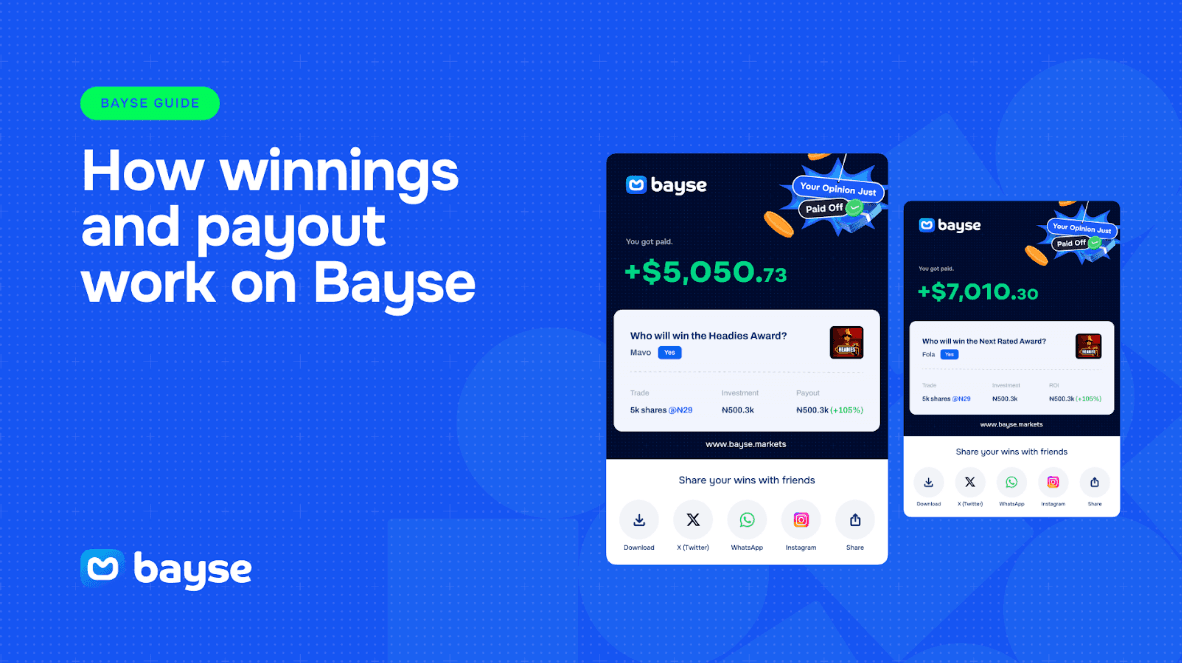
You’ve made a prediction, watched the price move, and now the event has happened. What comes next? This guide explains how winnings and payouts work on Bayse, from the moment a market resolves to when the funds actually land in your wallet, so there’s no guesswork around what to expect.
Explore: Make Your First Prediction
What Happens When a Market Resolves
Every market on Bayse is tied to a clearly defined resolution source, whether that’s an official match result, a confirmed election outcome, or another verifiable event source, stated upfront when the market was created. Once that real-world event concludes and the outcome is confirmed against that source, the market settles.
Settlement means the market’s outcome is finalized: one side is declared correct, and the other is declared incorrect. This isn’t a subjective call made after the fact, it follows directly from the resolution criteria that were visible on the market page the entire time you were trading.
How Payouts Are Calculated
Once a market settles, shares tied to the correct outcome pay out at their full fixed value, while shares on the incorrect outcome pay nothing. Your total payout depends on two things: how many shares you held, and the price you originally paid for them.
Here’s the key relationship to understand: the lower the price you paid for a share that ends up correct, the larger your return, since you’re capturing the full difference between what you paid and the full payout value. This is why prices matter so much while a market is still open, buying an undervalued outcome early, before the market catches up to new information, is where the bulk of the opportunity in prediction markets comes from.
Also Read: How to Fund Your Bayse Account
A Simple Example
Say you bought shares in a “Yes” outcome at 40 kobo each, and the market later resolves “Yes.” Each of those shares now pays out at full value, meaning you’ve captured the difference between your 40 kobo purchase price and the full payout, a solid return relative to your original stake. Had you bought the same shares at 80 kobo instead, closer to the point where the market was already confident in that outcome, your return on the same number of shares would be smaller, since there was less room between your entry price and the final payout.
When Payouts Land in Your Account
Once a market settles, payouts for winning positions are credited to your Bayse wallet automatically, without any action required on your part. You don’t need to manually claim a payout or submit anything, settlement and payout happen as part of the same automated process.
From there, your payout sits in your wallet balance just like any funded amount, ready either to be used for your next prediction or withdrawn. If you’re planning to withdraw, keep in mind that withdrawals require identity verification, covered in detail in our guide on how to withdraw from Bayse.
What Happens If You Sold Before Resolution
Not every position is held until the market settles. If you sold your shares earlier, whether to lock in a gain or exit a position you were no longer confident in, your return was already determined at the point of that sale, rather than waiting for the eventual market outcome. This is one of the more flexible aspects of trading on a prediction market rather than placing a single fixed-outcome wager, you’re not required to wait for the final result to realize a return.
Where to Track Your Payouts
Your portfolio keeps a full record of settled positions alongside your open ones, showing what you predicted, the price you traded at, and the resulting payout. This makes it easy to review your trading history and see which markets and categories have worked out best for you over time.
Why Entry Price Matters More Than People Expect
New traders sometimes focus only on whether they picked the right outcome, but on Bayse, when you traded matters just as much as what you traded. Two people who both correctly predicted the same outcome can end up with very different returns depending on the price each of them paid. This is why watching a market’s price history, and being willing to trade early when you have a strong view rather than waiting until the outcome feels obvious, tends to produce better results over time. By the time an outcome is widely expected, the price has usually already moved to reflect that, leaving less room for a meaningful return even if you’re right.
Reinvesting a Payout
Once a payout lands in your wallet, you’re free to use it however you’d like, leave it as a balance for your next prediction, or withdraw it. Many active users simply let winnings roll into their next trade rather than withdrawing and redepositing each time, since it’s the same balance either way until you choose to move it out.
If a Payout Looks Wrong
Settlement is automated and tied directly to each market’s stated resolution source, but if a payout ever looks off to you, the first step is checking the market’s resolution details against the actual real-world outcome. If something genuinely seems inconsistent after that check, Bayse’s support team can review the specific market and your position.
Frequently Asked Questions
Do I need to do anything to receive a payout? No. Once a market settles, payouts for winning positions are credited to your wallet automatically.
How is my payout amount calculated? It’s based on the number of shares you held on the winning outcome and the price you originally paid for them, the lower your entry price, the larger your return.
What happens to shares on the losing side of a market? They expire worthless once the market settles, with no payout attached.
Can I see my payout history? Yes. Your portfolio keeps a complete record of settled positions, including the price you traded at and your resulting payout.
Do I need to verify my account to receive a payout? No. Payouts are credited to your wallet automatically without verification. Verification is only required if you want to withdraw that balance.